“We were to blame for our disability,” said João, one of the voices at the protest against the World Youth Day
This text was originally published in Portuguese in the magazine TejoMag. The respective link is no longer available online, as the magazine no longer exists.
At Praça Martim Moniz, two opposing sides were represented: those who love God and the Church, and those who hate and fight it. We also found a young man who had freed himself from his chains and a curious Protestant. The night ended without incident, despite some exchanged provocations.
One hour after the start of the Way of the Cross of World Youth Day (WYD) on Friday, August 4, at Parque Eduardo VII, about a hundred young people gathered in a semicircle in the space in front of the Chapel of Nossa Senhora da Saúde. On the other side of the street, at the center of Praça Martim Moniz, images of Pope Francis were projected on a large stage. Various pilgrims wandered there, drawn to the different tents of Parque Cristonautas, an event that combined technology and faith.
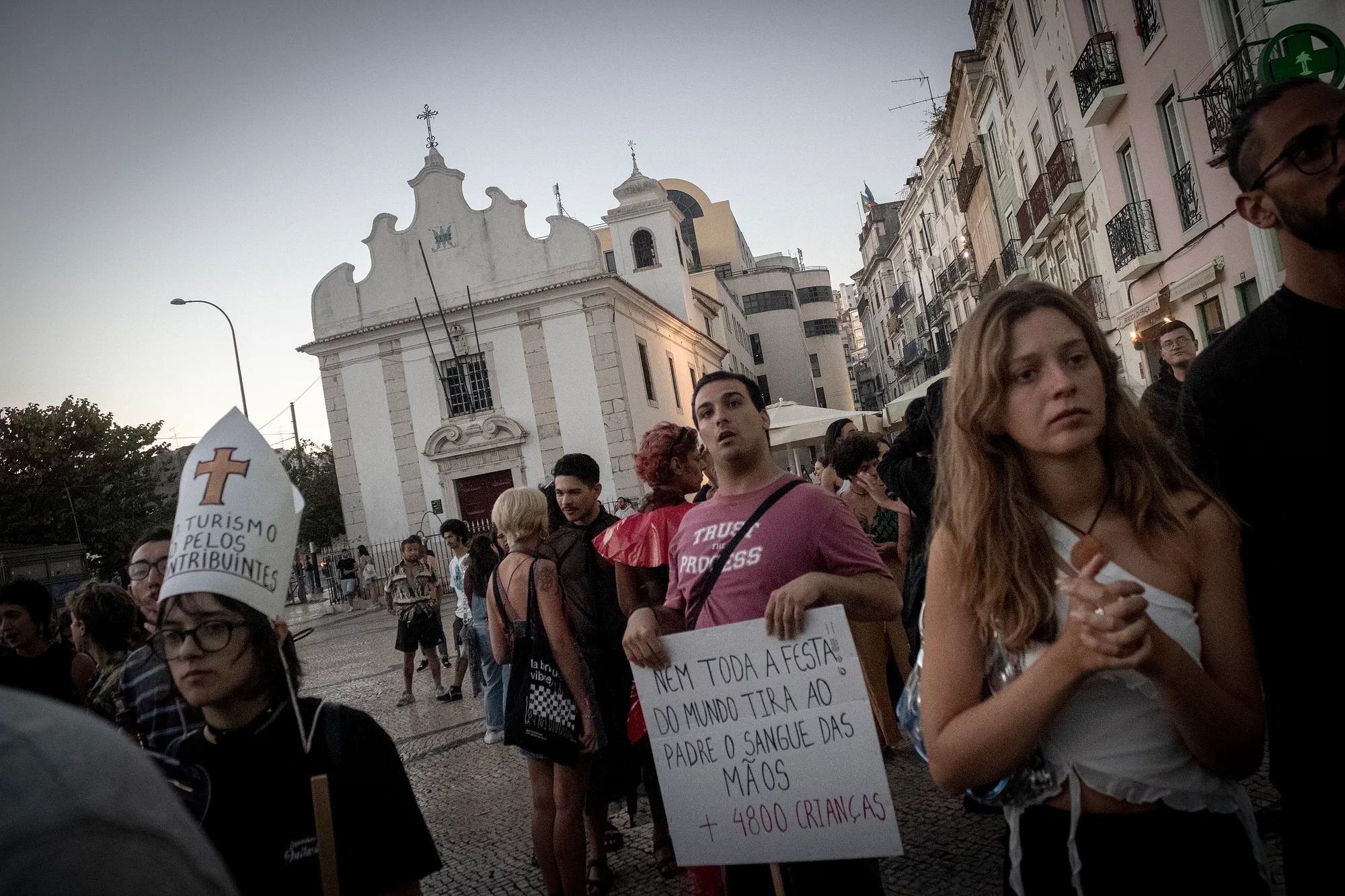
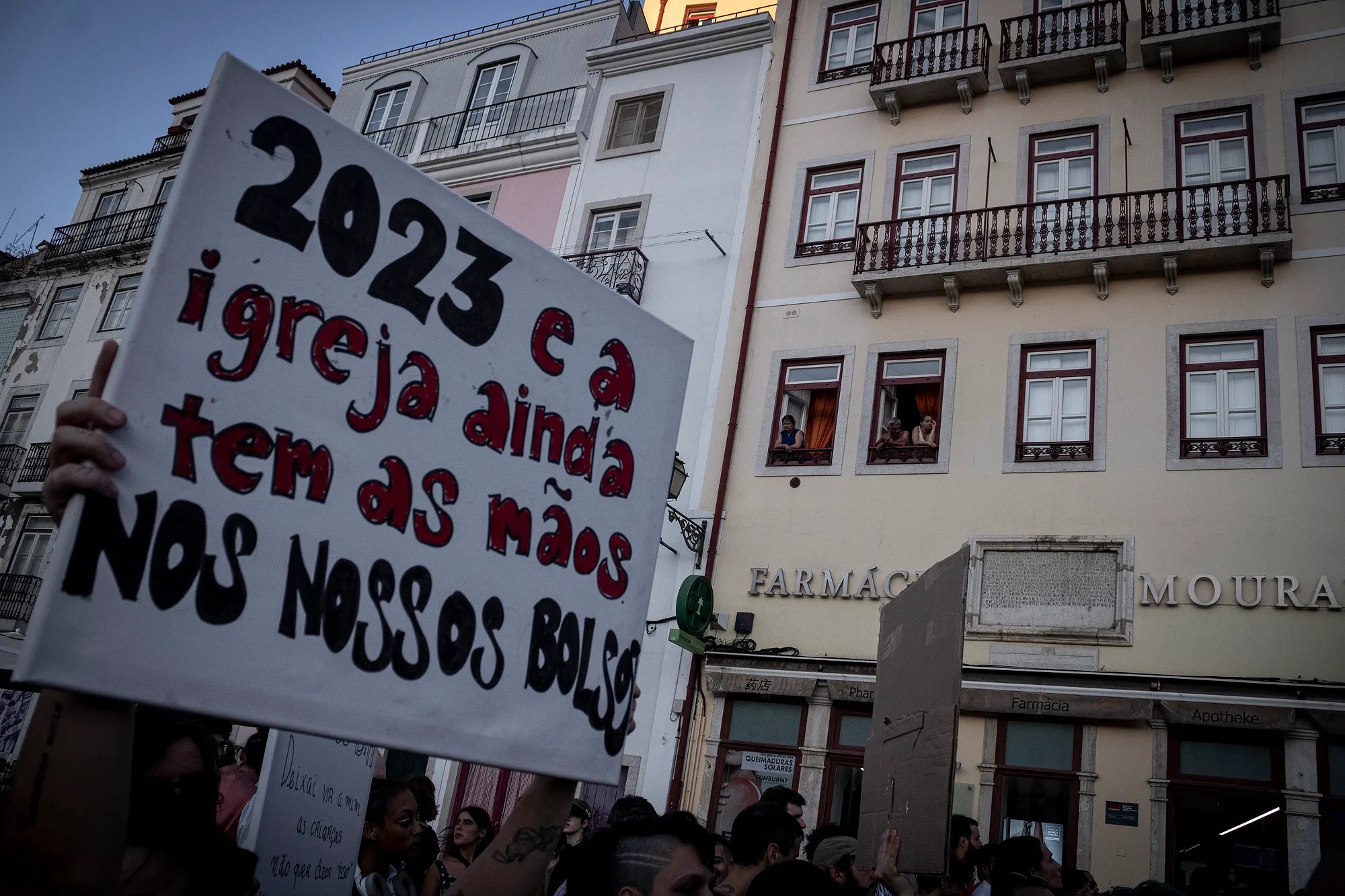
With a microphone in hand, under the shadow of these activities integrated into the official WYD program, the protesters from the Sem Papas na Língua gathering shared their concerns and personal testimonies in a tone of revolt. Stories about transgender issues, racism, police violence, and sexism united those present, who appeared to be between 18 and 30 years old. The posters reflected these messages: “love is stronger than tradition,” “treat Portugal as if the Pope were here all year,” and “4815 + 40: How many more need to be abused?”
Life in Catholic institutions
A 26-year-old young man with cerebral palsy, João Peres, mingling in the crowd from the start with a sign in hand, decided to take the microphone. What troubled him went beyond the topics discussed there, as it was an issue few remember: people with disabilities in Catholic institutions.
He was 12 when he realized, more for “emotional” than “rational” reasons, that Santa Casa da Misericórdia, the institution that took care of him during the day while his mother was working, undermined his self-esteem, using him to create the image of a church that “appears beside the poor and oppressed.” His mother, a Catholic by tradition, understood and respected her son’s wish to leave.
João had attended Santa Casa since he was six months old. He remembers going to Mass every Sunday, getting bored, thinking none of it made sense. And especially “being the doll, the disabled person they wanted there.” “The Church presents me as a sick, sinful person. There was an imposition of a way of living. Of religion, prayer, guilt. As if we were sinners for being this way. Less human, less equal to others. There was an idea that we were to blame for our disability. And that view is deeply rooted in how society looks at people with disabilities.”
Today, with a master’s degree in physics and employed, João lives independently because his disability allows it, which he considers “lucky.” Colleagues with more limiting motor disabilities, who are in wheelchairs, blind, or mute, “are underestimated and treated as trophies of goodness for the Church.” Placed in Catholic institutions against their will, they are restrained to beds, their freedom and right to say no are taken away, he says.
In the eyes of a Protestant
To those there preaching against the Catholic Church, others arrived, curious, and ended up staying until the speeches concluded. Duarte, 24, one of the organizers of the Parque Cristonautas activities, overcame the perplexity of the WYD participants observing the event at Praça Martim Moniz and crossed the street. “I come expecting to listen,” he said. “I feel these people suffered and continue to suffer in a way that is genuine, and I have compassion for that.”
Duarte is not part of the Catholic community. Despite participating in World Youth Day and helping organize the event at the Praça, he identifies as a Protestant Christian attending the Evangelical Baptist Church of Oeiras. Raised Catholic in Portugal, he found faith in Denmark while being hosted as an exchange student in a Protestant community. “There the Gospel became real for me.” It is these writings that unite both Catholics and Protestants in the brotherhood of faith. However, there are defining differences. One of them is how Protestant and Catholic believers would perceive that protest.
One of Duarte’s guiding principles is “none of us is good enough to deserve God’s love.” This is a prevailing feeling there, he says. A Catholic asserting that God’s love reaches everyone unconditionally puts some protesters at a disadvantage because “what the church officially says and what the faithful do are different,” he explains. “Here at WYD, you can see that. People behave stupidly toward the LGBT community, but you also have those who listen and suffer with them.”
Burning cross and provocative pilgrims
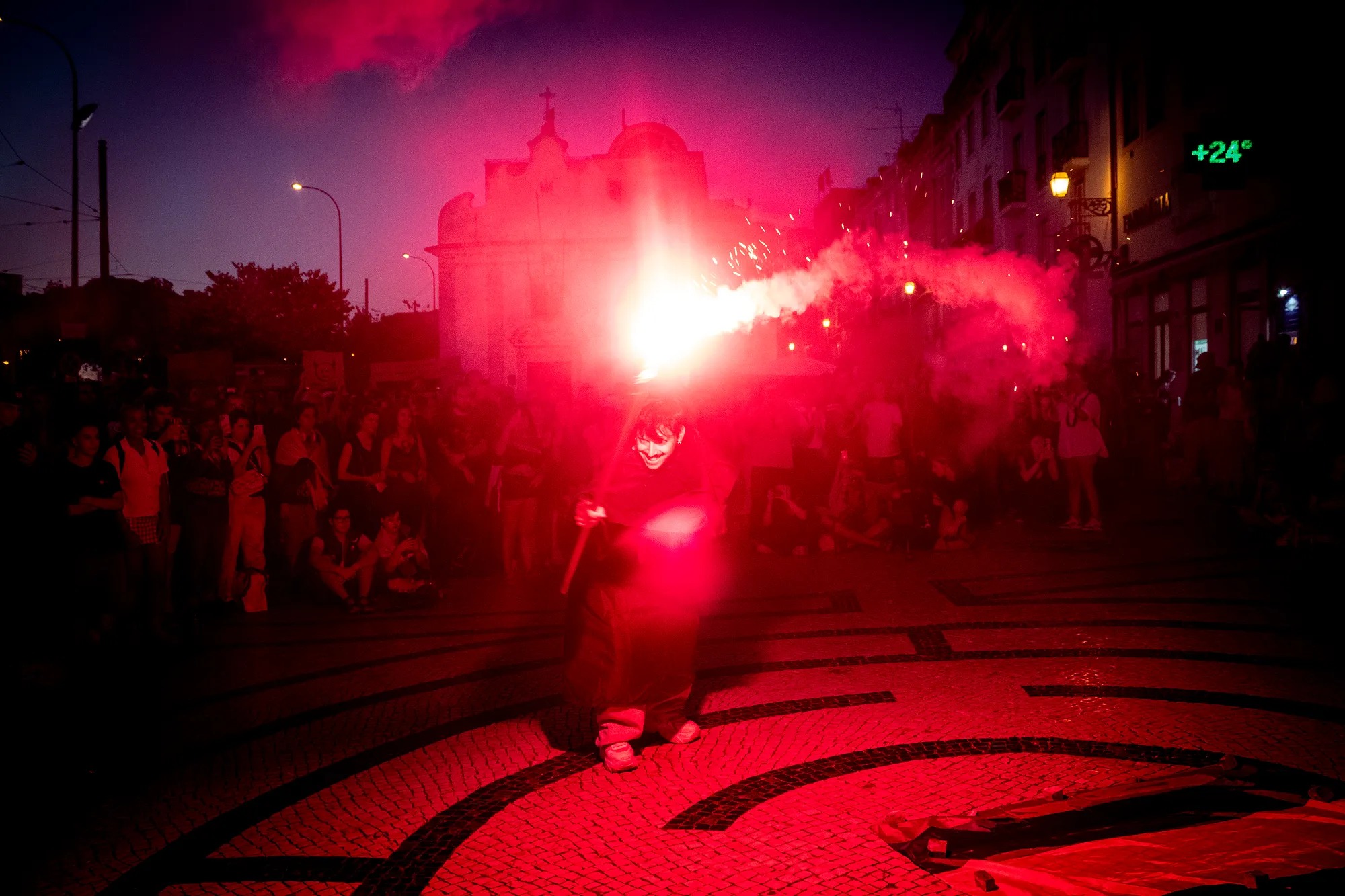
Before sunset, a young man dressed in a habit began a theatrical recitation of Bible passages warning about the violence perpetuated by the Church over the centuries. Under the light of a red flare, he spoke of colonization and the persecution of “witches” by the Inquisition. Inside the semicircle, near the bench, an LGBT flag with an anarchist symbol and some Marxist references could be seen. The protest organizers refused to be identified and declined to give statements, creating a hostile environment for journalists.
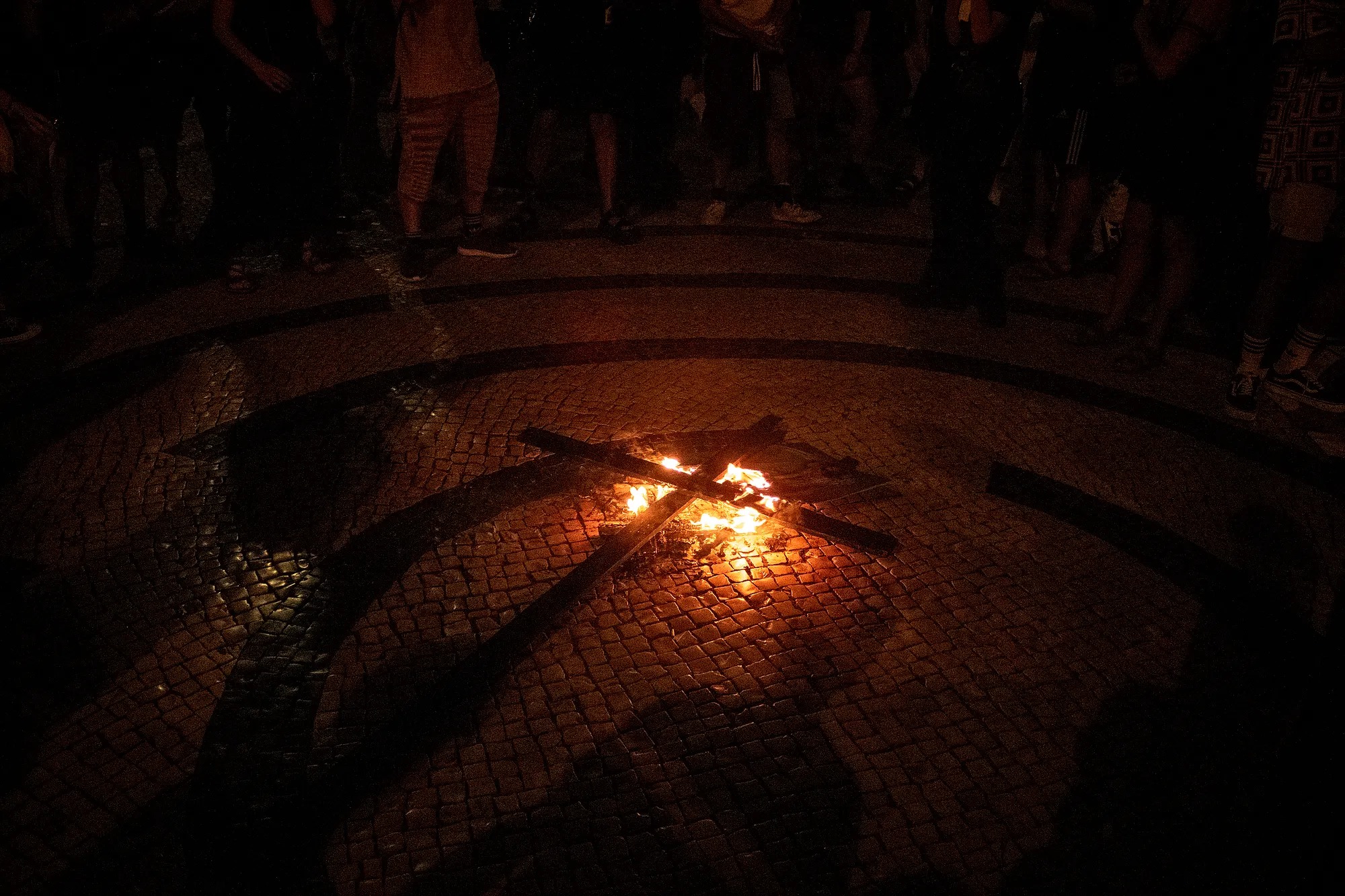
As night fell, more pilgrims arrived at Parque Cristonautas, gradually filling the entire square. In the area in front of Escadinhas da Saúde, the black garments of the protesters accentuated the purpose of what was to come. To techno music, the young people lit a small fire in the center of the semicircle and began burning a cross. The scene evoked a witch hunt.
Due to both the music and the spectacle itself, several WYD youth gradually approached, as had happened throughout the day. In brief hit-and-run encounters, the anti-WYD protesters received some provocations. A young man with a beer in hand and a Spanish flag on his back approached, pointed his finger impulsively, and shouted: “hijos de puta.” His companions, anticipating trouble, grabbed him and took him across the street.
When tensions seemed calm, a young man from the LGBT community, farther from the gathering, was allegedly thrown to the ground by a pilgrim. According to witnesses, the aggressor fled without giving a chance for identification. When questioned about the incident, none of the injured parties wished to comment. As far as could be determined, no one saw what happened except those involved.
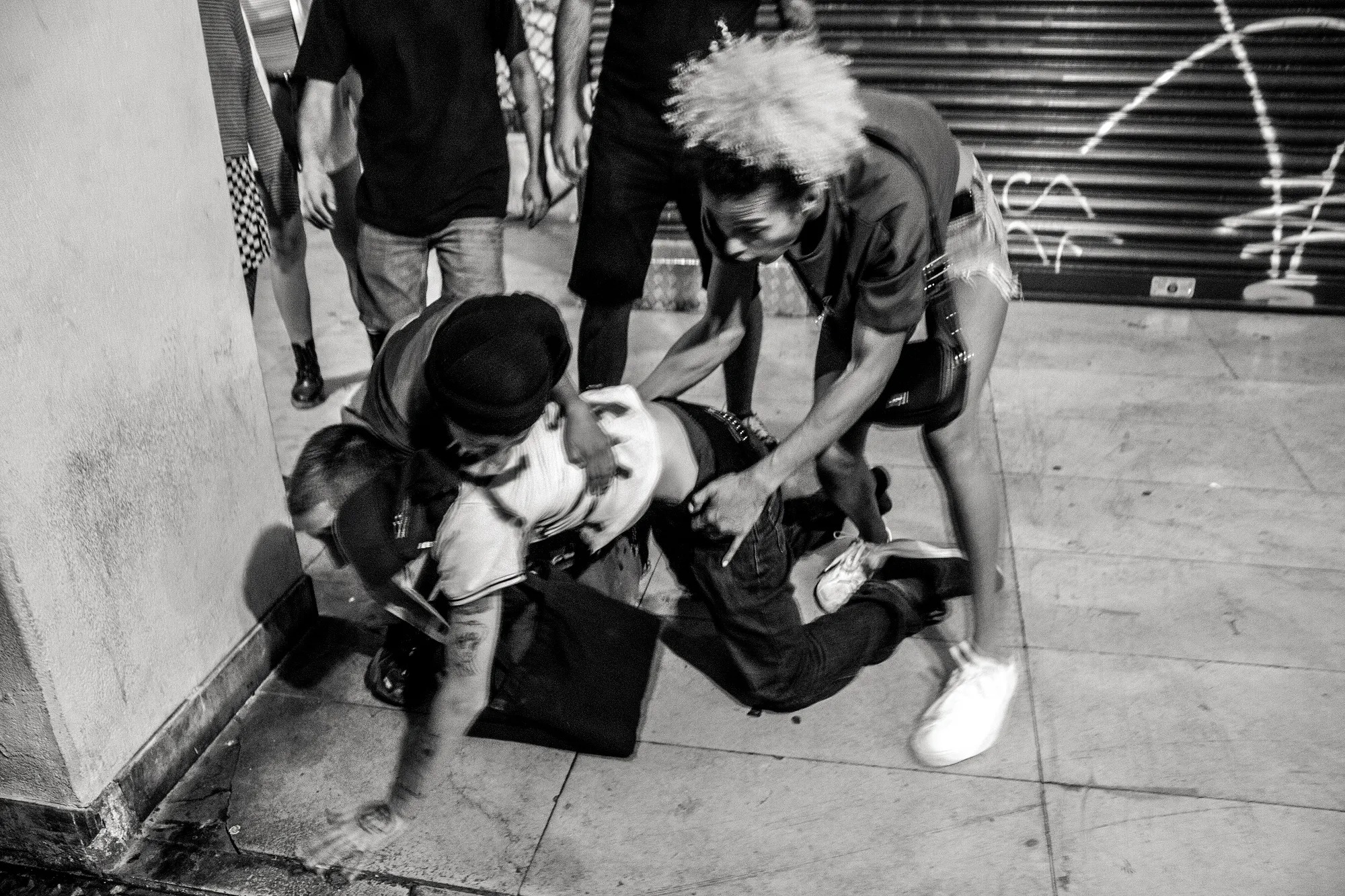
Photos by: Rafael Baptista
Post a comment