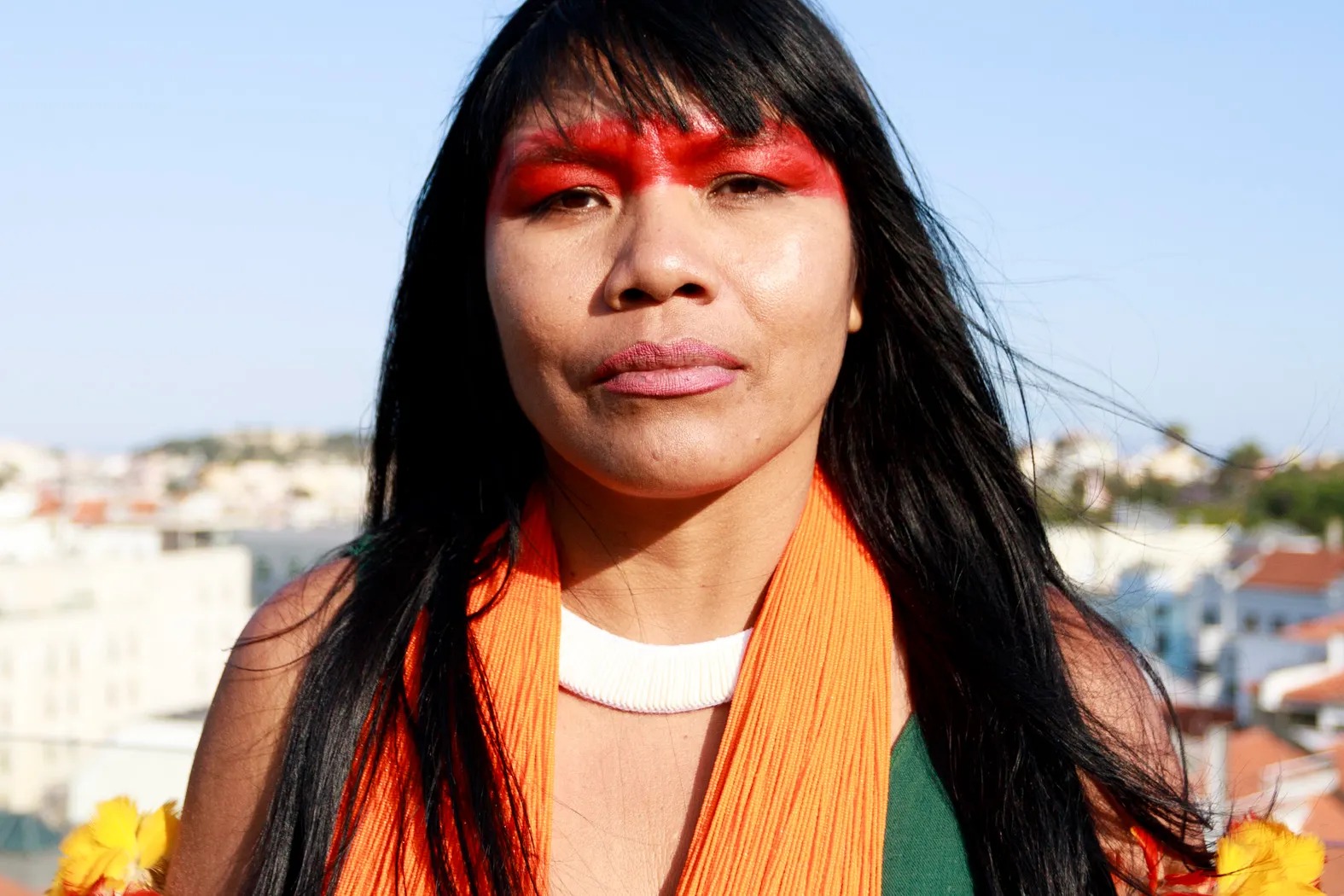
Watatakalu Yawalapiti: “I can support a president today, but not actions that will harm my life”
This interview was originally published in Portuguese in the magazine TejoMag. The respective link is no longer available online, as the magazine no longer exists.
The leader of the women of the Xingu Indigenous Land in Brazil believes that historical reparation must come through changes in consumption habits. Sexism, present in all societies, is challenged in the fight against climate change. And without dialogue, there is no negotiation with the Brazilian government.
At 42 years old, Watatakalu Yawalapiti is the face of the youngest generation of Indigenous people joining the Indigenous leader Raoni Metuktire, internationally known since the 1980s for spreading the message of Indigenous rights and Amazon preservation worldwide. The leader of the women of the Xingu Indigenous Land, who belongs to the Yawalapiti people, whose protected territory is located in the state of Mato Grosso, Brazil, came to Lisbon to participate in the first event of the global campaign Woman For the Amazon, which launched in the city.
Surrounded by European women, amid hugs and photographs, Watatakalu spoke last Thursday on the rooftop of the Mama Shelter hotel about her work coordinating ATIX Mulher and the Women’s Movement of the Xingu Territory. A pioneer in advancing women’s rights in her community, daughter of her people’s leader, she combines new technologies and the exchange of experiences across the Atlantic with the preservation of her traditional customs.
“The Indigenous communities disagreed during the governments of Lula and Dilma. That’s when your role as a defender of women’s rights began. What did you do to resolve your community’s problems?”
Being part of a female leadership, people may say women are free, but that is not true. Not any woman can speak. In a decision-making meeting, she may be heard only in parallel. As someone from a leadership lineage, I felt responsible to step forward. If a woman not from a leadership line took action, she wouldn’t be heard and might even face retaliation.
“Do your people’s customs make your community sexist?”
Completely.
“When did you realize you lived in a sexist reality?”
From very early on, having gone through an arranged marriage at 15. I married by family arrangement, and no one cared that I didn’t want to marry. That was the moment I realized that women had no will, no right to live their own lives.
“Was that decision not to marry influenced by the outside world?”
No. It was influenced by our own Indigenous culture. Because in every people and culture in the world, sexism exists or has existed. It is part of societies.
“Cultures have to evolve.”
Yes, but it’s not men who will change that. We women must do it. And at that moment, I decided to change.
“Are the traditional values of your people, such as the connection to nature, simplicity, and living in community, compatible with how European cities live?”
They are different ways of life. We say you live each in your own square, each thinking only of yourself. There we live collectively. You could learn from Indigenous people and live in community. Here, neighbors hardly even know each other. You could do things together.
“And are those values still preserved? Aren’t you becoming more individualistic?”
Indigenous peoples still maintain that value, even those who have mixed with white people. I’m speaking of regions like Bahia, Pernambuco… It’s part of our culture.
“What values were you raised with, and how do you remember your childhood?”
I remember the smell of the morning, going to the river to catch something that washed up… I was always treated as an adult from an early age because I was my father’s eldest daughter and my grandfather’s eldest granddaughter. I was born into a family of leaders. That’s why I never joined the children’s games. I had to care, always be ready in case someone called. I received teachings on how to behave and how to care for our people. And by care, I mean caring for the women.
“Girls are also raised to be leaders.”
Yes, they think we must set an example. Whatever we do with our lives, others will feel free to do too. Sometimes I was the only child among adults and was treated as an adult. My mother was also a cacique [leader] who carried our symbol on her arms.
“As a child, did you only know your community’s reality?”
My father started working for FUNAI (National Foundation of Indigenous Peoples) in 1984. He did territorial monitoring. He volunteered for two years before being hired by the government. At that time, he didn’t even know what it was. He just did the work. That was when I came into contact with non-Indigenous people. My family started hosting outsiders, and I began to understand your language. My father said that if I wanted, I could become a dentist. I even helped a dentist in the village office…
“Didn’t you like it?”
I liked it a lot. As a child, I went to the city twice. On one of those trips, I attended ECO92, my first conference on the Indigenous movement. I think that’s when my desire to become a dentist started to change.
“Did you start wanting to be an activist?”
Yes, because my father was already an Indigenous movement activist. I saw him fight for our rights. With the contact with non-Indigenous people came disease. Only 11 people from my people survived. We were in a recovery phase, and I am part of that generation of children.
“As a child, did your relatives already talk to you about climate change and fighting for your territory?”
My father was considered crazy because he already spoke about it. He said the weather would go mad: ‘The weather will take revenge on us. It will make our children and grandchildren pay for what is happening in the world today.’ People didn’t take it seriously, didn’t understand. ‘Non-Indigenous culture won’t affect us because we are safe here. We are surrounded by our healthy food, and white people will never enter here.’
“But then you started feeling the effects.”
They came immediately. You feel it in the forest. Here, you have air conditioning, and water comes directly from the tap.
“When did you start experiencing climate change?”
By 2000, we were already feeling it differently. Even though I had been following the struggle of my parents and grandparents, that year I realized something was wrong. What my father said should have been taken more seriously because white people wouldn’t do anything.
“How did your father understand climate change?”
He participated in the Indigenous movement within Xingu and communicated with various peoples from other Brazilian states. He realized that what was happening in our territory was what was being discussed in those places.
“What changes did you see in nature?”
Some birds began to change their habits, and flowers bloomed at the wrong times. Our crops didn’t grow because it didn’t rain. Insects began invading the village. The river became dark, dirty, and started drying up. And mainly because the sun started heating much more. It got worse, and today the biggest danger is fire. Before, we used fire for camps, and it would go out by itself. Today we cannot do that. We are changing our reality.
“Is it a point of no return?”
There is a solution, but it doesn’t depend solely on Indigenous peoples. In the city, you have your home, but you need to maintain it, and that has costs. Before, we didn’t need to maintain the forest because it took care of itself. Some areas aren’t even being used. Why not reforest them? Rich countries need to pay for people to do it.
“You believe foreign countries finance your projects, and that this is the best form of historical reparation. But as foreign countries are the main clients of the ranchers who destroy your lands through soy and corn plantations… Wouldn’t true historical reparation mean changing consumption habits?”
Yes, if they want to support us, it must be sustainable. We know that all things produced in Brazil that affect our territories come here. They say they are producing to put food on Brazilians’ tables. That’s not true. All production is exported. This responsibility also lies with Brazilian entrepreneurs. Talking about a carbon tax is useless.
“During the event, you said you don’t believe the Brazilian government can do anything to preserve your lands. But don’t you think Lula’s recent land demarcations were important? Or even the creation of a Ministry of Indigenous Peoples?”
That wasn’t given to us by the government. It was a struggle over years. We have our own representations. The Ministry of Indigenous Peoples is important, but any ministry can be dissolved at any moment. The demarcated territories don’t even cover half of mine. They are only for foreigners to see that they were demarcated.
“What does demarcation mean for you? What rights does it give you?”
For us, territory is life. By non-Indigenous law, our lands are for our exclusive use. The 1988 Federal Constitution worked very well during the pandemic because it was the only thing that ensured our territories survived. By placing a piece of our thinking into a white man’s document, we know it will serve future generations.
“Is Lula’s government more open to listening to you? He was in power before, and you didn’t support him. Recently, your stance changed, for example, when Chief Raoni ascended the ramp of the Planalto during the inauguration.”
When President Lula won for the first time, our people voted for him because we give credibility to people who want to do something for us. But we weren’t listened to. To do anything in Indigenous territory, you must listen. It’s not taking your thinking to the Indigenous. That’s the biggest first mistake of non-Indigenous people. It’s to command and want to own. We began to establish dialogue with the Workers’ Party government under Dilma. We fought against the Belo Monte hydroelectric dam. It flooded kilometers of forest, displaced many communities, and created a horrible city near the territory. And what did it bring? Prostitution, alcoholism, all drugs possible, and many people. It brought poverty because the work ended, and those families had to stay there. Now many are miners and invade protected Indigenous territories. I can support a president today, but not actions that will harm my life.
Photo by: Marta Raña
Post a comment