"The daily life of a trans person is not easy: it’s a painful one. I am ridiculed, questioned, and humiliated"
This text was originally published in Portuguese in Jornal de Notícias
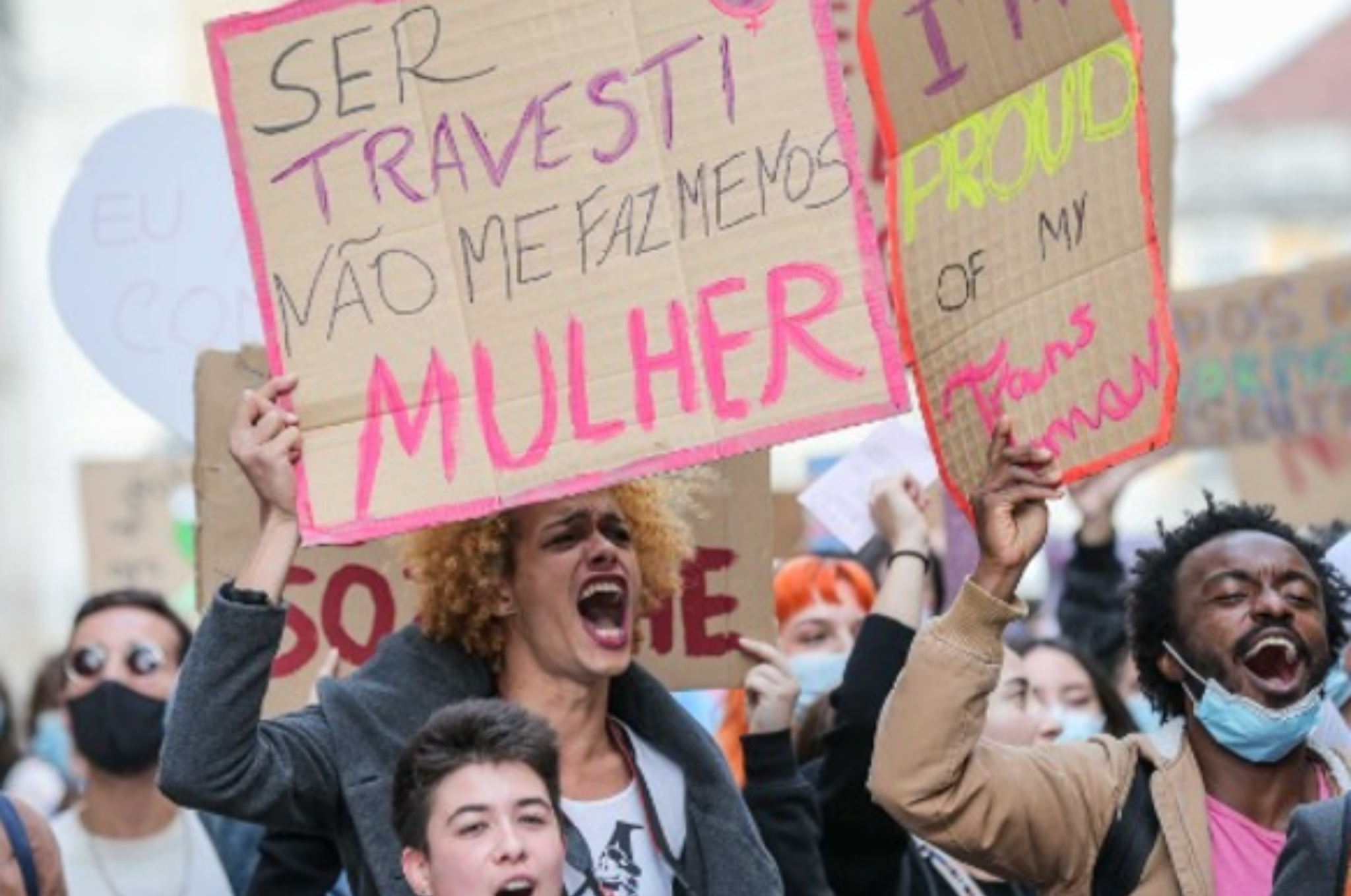
Aisha Noir, 27, gives body and voice to the difficulties of the trans community in Portugal. On Trans Day of Remembrance, hundreds of people gathered in Largo do Intendente, in Lisbon, to remember those who were killed by transphobic violence. They say there is still fear of walking the street and they demand access to more and better healthcare.
It was with satisfaction that Sasha, 36, noted this Saturday afternoon that at the location defined for the start of the march, Largo do Intendente, there were already about 60 people: "It's already a success," she concluded. It is the first "march specifically for trans issues," continued the activist, one of the organizers of the demonstration. The discrimination she felt from her family and those closest to her was the reason that led her to leave France, her country of origin, in 2014. "I was going through my transition and it was a time of isolation. I emigrated, just like many trans people, to start a new life," Sasha continued.
Beyond the lack of family support, the trans community also speaks of abandonment by the State. “We struggle to access housing and jobs. We are pushed into precarious conditions and marginalized. Migrants, women, and especially sex workers are the most vulnerable,” said Sasha. The hardships and suffering that trans people endure often lead to suicide. Despite the 2018 law on the Right to Self-Determination of Gender Identity and Gender Expression and the protection of each person’s sex characteristics, “it still isn’t being enforced.” Change could also be made within society, particularly in schools, she argued. “We need to stop with the lie that there’s only a binary world—women on one side and men on the other. That lie erases us and kills us,” she concluded.
Even before the march began, hundreds of people had already gathered. “Family” was a word echoed by many members of the trans community. That feeling was reflected in a warm, communal atmosphere. Many young people from the LGBT community were present, as well as people of all ages who joined simply out of solidarity.
The feeling of fear, even during a legal demonstration accompanied by police officers, led organizers to arrange their own security team. About ten people from outside the trans community walked alongside the demonstrators from the beginning of the march until the end of the vigil.
Transphobic attack in Bairro Alto
Aisha Noir knows what it means to feel afraid. Last Saturday, Aisha, 27, and her boyfriend, Lúcio Sousa, 28, were attacked outside a bar in Bairro Alto. The bruise still visible around Aisha’s eye is proof of the violence they suffered. “The daily life of a trans person is not easy: it’s a painful one. I am ridiculed, questioned, and humiliated,” she lamented. She left Brazil for the Netherlands and has been living in Portugal for a year. She knew transphobia existed in Portugal, but never imagined “it would be like this.”
At the entrance of the bar, they noticed “the security guard was bothered” by their presence. According to Aisha, that hostility happened because they were “two Black people and a trans travesti in an environment where people like us don’t exist.” Despite the threats, Aisha and her boyfriend went inside and even informed the staff about what had happened. No one reacted, and when they left the bar, the security guard attacked Lúcio. “Several others joined in to beat us. All I could feel were the punches and kicks. I screamed for help and nobody did anything,” Aisha recounted.
When they went to the nearest police station, they were told that a passport was not enough to file a report—they needed a “statement of intent.” The couple was outraged. Both are employed: she manages a bar and he teaches English. At the hospital, they were advised to go to another police station, where they were told the system was down. “I was left not knowing if that was even true,” said Aisha.
Backing up his girlfriend’s words, Lúcio explained that they’ve been “subjected to a series of attacks.” He added that “you can see it in the looks we get—people are uncomfortable with us wherever we go.”
Barriers to healthcare access
At Praça do Município, a small stage was set up where various testimonies were shared, interspersed with musical performances by trans artists. One of the speakers was 20-year-old Alexandre Sacramento, who began his transition at 16. Transitioning—changing one’s sex—is a significant and fundamental transformation in a trans person’s life, but not everyone can access it. “I even considered suicide,” he said, because in Portugal, “either you have money, or you stay as you are. The problem is figuring out how long we can endure.” Public healthcare offers “very few hospitals” equipped for this, which makes the process especially difficult for people living in the south of the country or on the islands. On top of that, wait times are extremely long.
But Alexandre considers himself “a rare case.” His parents understood his situation and paid for private treatment to allow his transition. Even basic healthcare—like access to gynecology appointments—remains difficult for the trans community.
Guadalupe Amaro, 26, added that “medical language needs to be more scientifically accurate, because that would make it more inclusive.” She gave several examples: “A trans man is legally recognized as male and, automatically, the system excludes him from cervical cancer screenings. That means people are discriminated against because of the legal recognition of their gender, when what should matter is the organ relevant to the medical procedure.”
During the vigil, candles were handed out and a minute of silence was observed for all victims. Among the emotional testimonies, one case remembered was that of Angelita Correia, a trans woman found dead in Matosinhos.
Strengthening protections for the trans community
On Saturday, the Ministry of Internal Administration announced that it had signed a cooperation protocol between the Commission for Citizenship and Gender Equality, the Inspectorate-General of Internal Administration, the General Secretariat of the Ministry of Internal Administration, the National Republican Guard, the Public Security Police, and the Immigration and Borders Service for “training and capacity-building of key professionals to improve assistance, support, and protection for lesbian, gay, bisexual, trans, and intersex (LGBTI) people,” as well as for the “prevention of homophobic and transphobic violence, and to improve response and investigation in cases of crimes against LGBTI people.”
This initiative is part of the first independent plan to combat discrimination based on sexual orientation, gender identity and expression, and sex characteristics, under the National Strategy Portugal + Equal.
Photo by: Gerardo Santos / Global Imagens
Post a comment